
Mosquito Protection Does Not Stop at Your Bedroom Door
Most people think of mosquito nets only in the context of indoor sleeping. But mosquito exposure is often far greater outdoors — especially during camping trips, trekking expeditions, farm stays, and open-air sleeping on terraces or verandas during hot Indian summers. Without the right protection, outdoor sleeping can expose you to significantly more mosquito bites than staying indoors.
The good news is that there are mosquito nets specifically engineered for outdoor use. These are built tougher, designed for quick setup without fixed infrastructure, and offer reliable protection even in high-mosquito environments like forests, riversides, and agricultural areas.
What Makes an Outdoor Mosquito Net Different
Outdoor mosquito nets differ from standard bedroom nets in several important ways. The material is typically heavier-duty polyester or nylon that resists snagging on branches, rocks, and rough surfaces. The mesh is treated with UV-stabilizing compounds so prolonged sun exposure does not degrade the fibers as quickly as it would with indoor nets.
Most outdoor nets are designed to be self-supporting or to attach to existing structures like tent poles, tree branches, or trekking poles — eliminating the need for ceiling hooks. They pack down into compact stuff sacks and weigh very little, making them easy to carry in a backpack without adding significant load.
Many outdoor nets also include ground sheets or tuck-under flaps that seal against the ground or sleeping mat, preventing crawling insects from entering from below — a risk that does not exist with elevated bedroom beds but is very real when sleeping on the ground or on a low camp mat.
Types of Outdoor Mosquito Nets
Hammock mosquito nets are among the most popular for outdoor enthusiasts. They wrap completely around a hammock and zip shut, creating a fully sealed sleeping pod between two trees. Ventilation is excellent because the net surrounds you with airflow on all sides, and the elevation keeps you away from ground-level insects entirely.
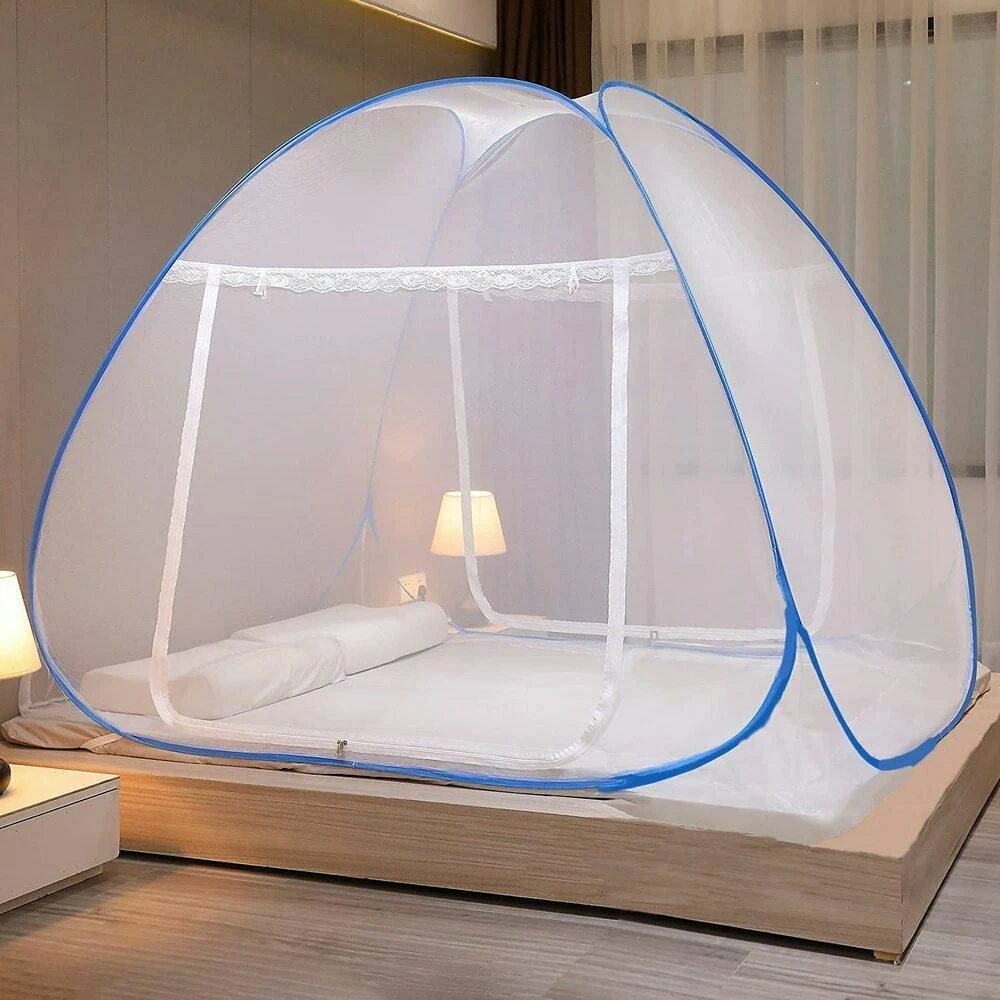
Freestanding pop-up nets are the fastest to set up and pack down. They work exactly like a pop-up tent — unfold, allow the frame to spring into shape, and place over your sleeping mat or sleeping bag. They are ideal for casual campers and travelers who need quick protection without any assembly skill.
Trekking pole nets use your existing trekking poles as the support structure, suspending a net over your sleeping area without requiring trees or tent frames. This makes them extremely versatile for open terrain like highland meadows or rocky campsites where trees are not available.
Bivy nets are ultralight single-person nets designed for minimalist trekkers and mountaineers. They are essentially a net sleeve that you slide into alongside your sleeping bag, providing a snug protective shell with almost no packed weight or volume. These are the choice of serious long-distance trekkers where every gram counts.
Key Features to Check Before Buying
Mesh density matters outdoors just as much as indoors. In forested and jungle environments, smaller biting insects like sand flies and midges are common alongside mosquitoes. A mesh density of at least 156 holes per square inch is recommended for jungle and forest camping.
Check the packed size and weight carefully. A net that is too bulky defeats the purpose of carrying it on a trek. Good outdoor nets weigh between 150 and 400 grams and pack to roughly the size of a water bottle.
Look for reinforced hanging points and zipper entries. The hanging loops and attachment points take significant stress when the net is suspended between trees or poles in windy conditions. Reinforced stitching at these stress points prevents tearing over repeated use.
Using Mosquito Nets on Indian Rooftops and Verandas
In many parts of India, especially in smaller towns and villages, sleeping on the rooftop or veranda during summer is a common practice. This is one of the highest mosquito exposure situations possible — you are completely in the open during peak mosquito hours with no walls or screens to reduce exposure.
For rooftop sleeping, a freestanding pop-up net or a portable frame net that can be assembled over a charpoy or mattress laid on the ground is the most practical solution. These require no drilling or permanent fixtures and can be set up and packed away each evening in under five minutes.
Ensure the net fully covers the sleeping surface and is weighted or tucked at the edges to prevent wind from lifting it. In windy conditions, place heavy objects like shoes or water bottles along the base perimeter to keep the net sealed against the ground or mattress edges.
Care and Maintenance for Outdoor Nets
After each outdoor trip, inspect the net carefully for holes, tears, or insect damage before storing. Wash it with mild soap and cold water to remove dirt, sweat, and any residues from the environment. Dry it fully in the shade before folding and storing to prevent mold in the mesh.
Store outdoor nets separately from sharp camping equipment that could pierce the mesh during transport. A dedicated small stuff sack or pouch keeps the net protected and easy to locate quickly when setting up camp after a long day of trekking.
Conclusion
Whether you are a serious trekker, a casual camper, or simply someone who enjoys summer rooftop sleeping, the right outdoor mosquito net transforms your experience completely. Protection from mosquitoes outdoors is not optional in India — it is a necessity. Invest in a good outdoor net and explore the outdoors freely without the constant threat of bites disrupting your rest and your health.