Illustration

Welcome Back!

Log in to your account

Forgot Password?
Illustration

Apply for Loan

Fill the form to apply for a loan

Blog Details

Home Our Blogs Best Mosquito Nets for Babies and Tod...
Best Mosquito Nets for Babies and Toddlers: What Every Parent Must Know Health & Safety
11 April 2026 8 Min Read 27 Views

Best Mosquito Nets for Babies and Toddlers: What Every Parent Must Know

Babies are the most vulnerable to mosquito bites and the diseases they carry. Learn how to choose the safest, most effective mosquito net for your infant or toddler.

Why Babies Need Special Mosquito Protection

Infants and toddlers have thinner skin, developing immune systems, and no ability to protect themselves from mosquito bites. A single bite from an infected mosquito can cause serious illness in a baby — and unlike adults, babies cannot communicate their discomfort clearly, which means infections can go undetected until they become serious.

Standard adult mosquito nets are not designed for cribs, cradles, or baby cots. They may be too large, have mesh that is not fine enough, or use materials that are not safe for close contact with an infant. This is why choosing a dedicated baby mosquito net is so important.

Key Features to Look for in a Baby Mosquito Net

When selecting a mosquito net for your baby, the mesh density is the most important factor. Look for nets with at least 156 holes per square inch — this is fine enough to block not just mosquitoes but also smaller insects like sand flies and gnats that can bite through coarser mesh.

The material should be soft, lightweight polyester that does not scratch or irritate delicate baby skin if it makes contact. The net should be completely untreated — never use an insecticide-treated net for infants under six months old, and exercise caution with older babies as well. Physical protection alone is sufficient and far safer for young children.

Size and fit matter enormously. A baby net that is too loose can sag and make contact with the baby, while one that is too small may leave gaps. Measure your crib or cradle before purchasing and choose a net with a fitted elastic edge or adjustable attachment that ensures a snug, gap-free seal.

Types of Baby Mosquito Nets

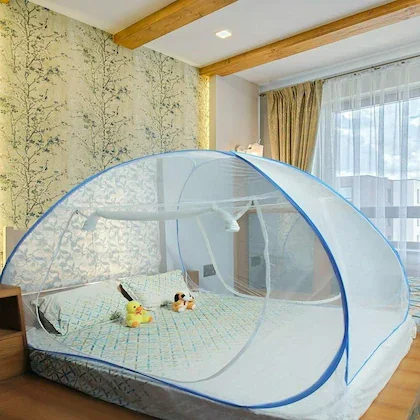
Crib dome nets are the most popular style for newborns and young infants. They sit over the crib like a dome, held up by a lightweight frame or flexible hoops, and have an elastic base that grips the crib edges. They are easy to open and close for feeding and diaper changes, and they fold flat for storage or travel.

Pram and stroller nets are designed to cover baby prams and strollers when you take your baby outdoors. They attach with elastic or drawstrings and provide protection during walks in parks, markets, or any area with mosquito presence. These are an absolute must if you take your baby out during early morning or evening hours when mosquitoes are most active.

Portable pop-up baby nets are freestanding and can be placed over any flat sleeping surface — whether a mattress on the floor, a travel cot, or a bed at a relative home. They are ideal for families who travel frequently and need reliable protection away from home.

Cradle nets are specifically designed for traditional Indian jhula-style cradles. They wrap around the cradle frame and tuck securely underneath, providing complete coverage while allowing airflow to keep the baby comfortable in warm weather.

Safety Rules Every Parent Must Follow

Never leave a baby unsupervised inside a mosquito net that has a frame or hoops that could collapse. Always ensure the net is taut and properly secured so it cannot fall onto the baby. Check for holes or tears regularly — a hole large enough for a finger is large enough for a mosquito.

Keep the net away from any fan or air conditioning vent that could cause it to billow inward toward the baby. When the baby starts rolling or moving around independently, upgrade to a net with a more secure base to prevent them from pushing the net aside.

Wash baby nets more frequently than adult nets — every one to two weeks — using a gentle, fragrance-free baby-safe detergent. Rinse thoroughly and air dry in shade. Never use the net if it is still damp as moisture can encourage mold growth in the mesh.

When to Use the Baby Net

Use the net whenever your baby is sleeping, regardless of the time of day. Aedes mosquitoes, which carry dengue, are active during daytime hours — so daytime naps require just as much protection as nighttime sleep. If your baby naps in a pram or on a play mat on the floor, cover them with a net every single time.

When outdoors, always use a pram net — even in areas that do not seem heavily infested. Mosquitoes can be present even in clean, dry environments, and a single bite is all it takes to cause a problem.

Top Tips for Choosing the Right Baby Net

Always buy from a reputable brand with clearly stated mesh density specifications. Avoid nets with strong chemical smells as these may indicate undisclosed treatment. Check that the net material is certified non-toxic and free from harmful dyes. Choose a design that makes nighttime feeding easy — quick-release or zipper access panels are extremely helpful for parents during night feeds without fully dismantling the net each time.

Conclusion

Your baby deserves the safest sleep environment possible. A well-chosen, properly fitted mosquito net is the single most effective and safest way to protect your infant from mosquito bites throughout the night and during daytime naps. Invest in quality, check it regularly, and use it consistently — the health and peaceful sleep of your baby depend on it.